Showing posts with label baseball. Show all posts

Monday, April 5, 2010

Business Lessons learned from little league, part 2

Coaching 9 and 10 year olds can be a great way to learn some business lessons. Especially on how to deal with unique circumstances and "interesting" perspectives on proper conduct.


Not everyone will listen or play along - whether they be your boss/es, coworker/s, or direct report/s it is a guarantee that despite your infinite wisdom and perfect plan that people will both willfully and unintentionally not go along. On the ballfield there are two types of mistakes: physical and mental. Physical mistakes are to be tolerated and corrected, mistakes happen, people throw the ball too hard or too soft, swing and miss, etc. That is life, and sometimes innate abilities can't match the situation.

But mental mistakes? No no no. These are because people are not paying attention, were not listening, were not thinking, etc. These cannot be tolerated.


In the workplace, those who unintentionally stray from the path need to be corrected and brought back into the fold. Honest mistake, no harm no foul, etc.

Those who intentionally won't go with the plan, well there are hundreds of books written on how to deal with those people. I simply recommend making it clear what expectations are, and keeping a log of willful disobedience. For my little leaguers this can result in a player/coach/parent meeting, emails to parents, etc. Typically these are resolved with a one-on-one meeting between the player and coach. But not always...
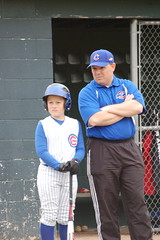


Match abilities to the situation - Don't put the least skilled and least experienced player on the pitcher's mound. It is principally not fair to them, and secondarily not fair to the team. Don't put your newest consultant in front of a senior executive to give a presentation they didn't create, and don't intimately know. This should be obvious, but in sports and business we make this mistake a lot.


Give everyone a chance - However you define a "fresh start" in business, make sure this opportunity exists. On a little league team, this should be the beginning of the new year. For consultants, when you go to a new project you should enter with few biases and a chance to prove yourself. You shouldn't be fighting an uphill battle. Lots of times little league coaches talk to each other about players and bias each other "Timmy was afraid of the ball" "Billy was a bad shortstop" "Sally can't pitch". These are kids, they mature in the blink of an eye, give them a chance to prove themselves. Don't be their enemy to start off with. Same for employees, give them a chance.

(that being said, fool me once shame on you...)


The great pictures, in order, come from:
  1. on2wheelz
  2.  stuartmoulder
  3. ArkansasSportsPhotograp hy.com
  4. stuartmoulder 

Friday, April 2, 2010

How to be a Little League coach


Being a little league coach is a wonderful challenge, so here are a list of tips on how to be a first time coach:
  • Get to know the game - If you don’t know baseball well, and you don’t have to, read up on it and watch some games. I highly recommend anything by Cal Ripken, even though his business/brand competes with Little League’s. His books on coaching are very approachable, aren’t bloated with 4 billion drills, and actually talk about coaching.
  • Have a plan – I’m a bit of a planner (though my wife at times would disagree), but when it comes to work and coaching I think a plan is a must. A plan for what you ask? Nearly everything:
    • A plan for the season – As David Allen says “Start with the end in mind”
    • A plan for each practice – Also quoting Mr. Allen “First things first”. Know what you are going to do that day to get you one step closer to the season’s goal/s. The older your kids the more credibility you lose when you are stumbling and bumbling trying to figure out what to do next, especially if you draw a blank. So get out a post it note or index card (or your iPhone, whatever) and write down the 3-6 things you want to do in practice, set a time limit for each, and use a watch or timer to keep on track.
    • A plan for each kid – This is potentially the hardest and most time consuming thing I recommend for coaches, but I think this is what can take you from a good coach, to someone who really makes a difference in each athletes life.

  • Communicate with the parents - You will want to make sure they understand the team and requirements for what their child is required to do as a member of the team.
    • Like the old saying about voting in Chicago, "early and often". Obviously do an introductory email to the parents. This would be an opportune time to layout some groundrules and expectations. If the team is at an age where competition is a priority, let them know. If these are 7 year olds, make it clear that player development is most important. Provide links to to the league website (which they should have if they signed up!), the schedule, field locations, and maybe a few parent resources you may come across.
    • Make sure they know about the practice schedule, changes to practices times or locations, changes to game times and locations.
    • Solicit (demand politely) volunteers. On our team we have scorekeepers, pitch counters, snack providers, and the team parent organizer to keep everyone on track.
  • Make a connection with each player - Learn about what they did in a prior season, positions they like or dislike, have them set a goal or two for the season, figure out who their friends are on the team. Help provide them with a familiar touchpoint to the season, league and sport. You could be the person they look back on as that most important coach (don't expect anyone to thank you in 20 years if they win the World Series though).
  • The biggest cliche of them all, have fun - Which mostly means get out of their way. They're kids, they know how to have fun. Try to build some time into the schedule for a little goofing off. Intentionally plan some goofy drills. Learn how to make fun of yourself. Joke around with them, but not at their expense.Expect some hiccups - You won't know what they will be, and they'll be new every year. Kids will forget equipment, they'll show up an hour late for a game. They'll suddenly get sick or go on vacation.

An almost last note - you will inevitably encounter some "challenging" parents. I try to keep the perspective that they parent just wants the best for their child, but may have an odd way of showing it. I had a parent challenge me and my coaches one year on the equity of playing time. This was in an 11 and 12 year old league. The 12 year old's parents wanted us to play them more than the 11 year olds because this was their last year in fairly non-competitive play.


I understood their point, but made it explicitly clear how playing time works on my teams - I keep the time as equal as is possible given all the factors. So no, I was not going to play a 12 year old more than an 11 year old due to age. Just like I wasn't going to play the kids I liked the most. Or who were the best, etc. It was fair play, all the time.

To sum up: have fun, get the kids to play hard, and hopefully they'll learn to love the sport for a lifetime. 


Superb picture attribution in order of appearance

Tuesday, March 3, 2009

Business Planning, UR duing eet rng

Corporate business planning is broken in a wide range of ways:
  • Those who have to execute it rarely have a say
  • It is usually based off of projections that are fully divorced from reality
  • Plans use flawed estimations for completion
  • They assume resources that don't exist
  • They require assets and skill sets that the company doesn't have
  • They dramatically alter the DNA of the company
And other very valid reasons.


But there is one bigger picture issue at heart - A full calendar or fiscal year business plan is too long, too cumbersome, and allows too long for most initiatives.

This last element is called Parkinson's Law, whereby a task will take as long to accomplish as it is given.

A better timeline for plans
Six months is too short. Once planning is completed, resources are obtained and put into action it would almost be time to report on completion. Planning would be constant, burning too many resources, corporate staff and confusing employees ("What's the new strategy this month?").

Not to mention how confusing it would be to customers.


Nine months though is a near perfect fit.

Nine months is enough time to complete the planning cycle and allow for implementation of meaningful programs. Resources can be obtained, there is sufficient time to complete almost any major program and can (and should) include an interim status check based on substance.

A nine month based planning and action cycle also helps the organization create momentum by demonstrating its ability to implement meaningful change (another drawback of a shorter period would be the scale of change would be smaller).

And programs that truly need more than nine months will be broken up into multiple phases. You won't arbitrarily decide to make things 9 months, you'll make them as long as they need to be but use discrete elements (chunks of change) that fit into the 9 month period.


A future that will never be
Nine months though, will never be adopted. The year long cycle is too engrained, aligns (arbitrarily, with no real benefit) to the financial and tax reporting cycles, and fits in the mental model that we have all adopted (witness the yearly habit of people making resolutions that they don't keep).

Sunday, March 30, 2008

Nats v bAAAltimore

Great day for a game:

(You know that picture you've taken that you think is amazing, and you show all your friends, and they humor you by saying "Oh yeah, that's awesome dude...." well the above is my version of that picture. I dig it, and I now have "proof" I'm a great photographer)

How do we know we're heading to the game? No, not the massive amount of construction and peddlers and protestors ("vendor gentrification"??? I guess they didn't see the vendors inside...) No no, because of fancy street signs:


Did someone say "Presidents Race"?


They did, and how do we know, there's a GIANT sign:


And guess who isn't in this picture, coming in a lame last place, again:


Best beer selling machine ever (check out the standard issue Hawaiian shirts with the big "w" on the chest for the vendors):

New year, same old lines (and it's blurry because of the migraine everyone got from the lines):


Hey look, new year, same old sucky Screetch:


Does any other MLB team have cheerleaders?

(and it took me about 15 pictures to show some girls in skirts????)


Tommy J knocking over fans after his victory:

(I also lamely named this "Jefferson Moving On Up" on my phone, I'm a dork)

I think I know the name at the top of the screen. And if so, Mr. Mark Fratto loves puppies, old people, and kids:


Oh, this picture made me famous today:


Marching triumphantly towards the real 2008 season:


So what did we get out of the evening? That's right, a useless yet regionally important:


GO NATS!

Lijit Ad Wijit